Say you tell a chatbot, "book me a flight to Dubai."
Nine times out of ten, it'll come back with something like, "I can't book flights directly, but here are a few sites that might help." Not exactly what you wanted.
Now ask an AI agent to do the same thing. It goes off, checks flight options, compares prices across a few sites, picks a decent one, and actually books it. No back-and-forth, no links dumped in your lap.
Same sentence typed into two different tools. Wildly different results.
This is basically why the questions "AI agent vs chatbot" and "is ChatGPT an AI agent" keep popping up everywhere. On the surface these things all look alike — you type something, they respond — but underneath, they're built for pretty different jobs. Worth untangling.
Chatbots vs AI Agents
A chatbot's whole job is conversation. Answer a question, hand over some info, walk someone through a scripted flow. Some of them are genuinely impressive at sounding natural these days, but that's usually where it ends — they talk, they don't do.
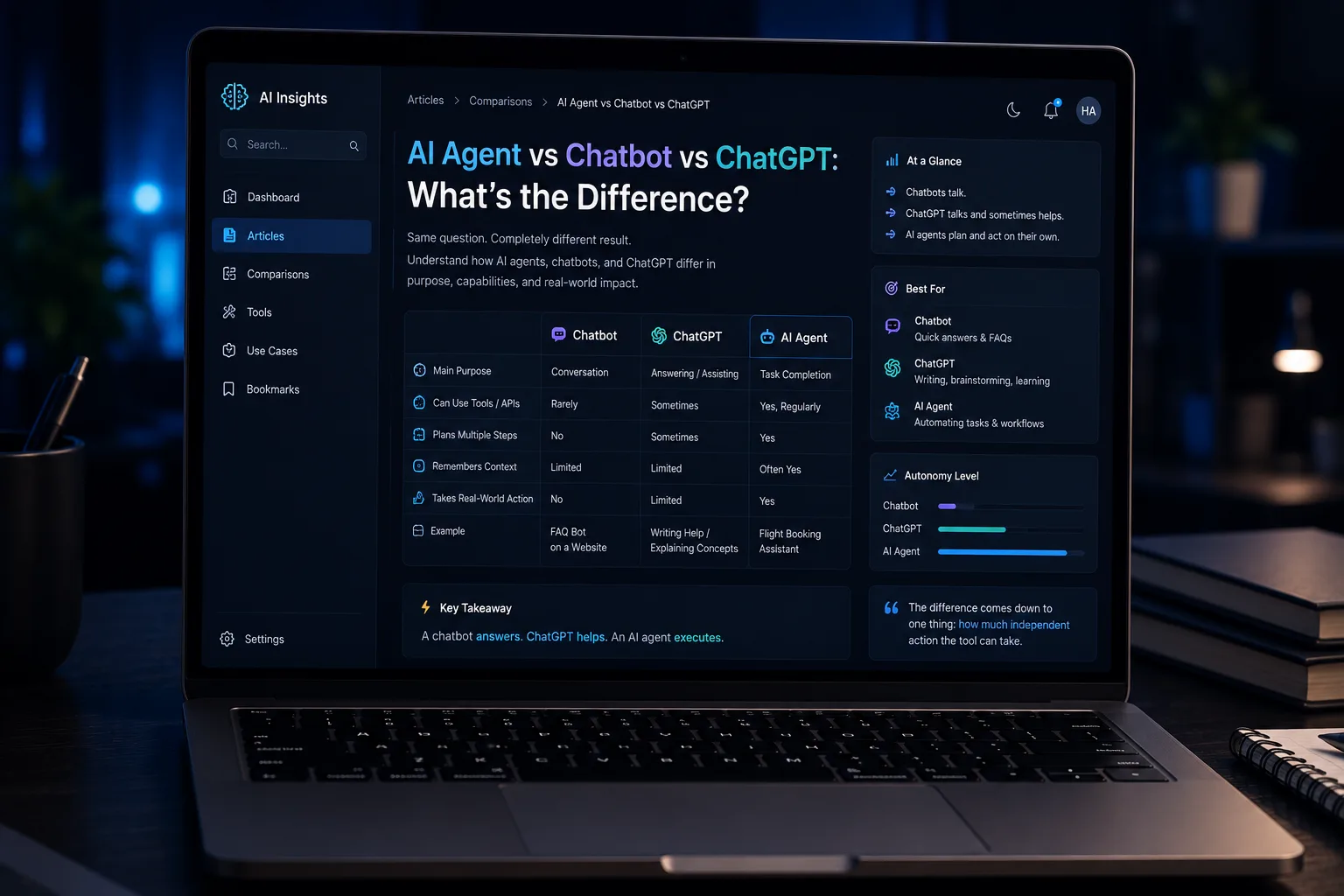
An AI agent picks up where that stops. Give it a goal, and it can figure out a plan, reach for different tools along the way, string together multiple tasks, and change course if something doesn't go as expected.
Shortest way to put it:
Chatbots talk. Agents act.
A few things that separate them:
- What they're for — chatbots exist to have a conversation; agents exist to get something done.
- Tools — a chatbot rarely touches anything outside the chat window. An agent might be pulling from your calendar, sending emails, hitting an API, or poking around a database.
- Planning — chatbots basically respond one message at a time, no real lookahead. Agents can map out several steps before they even start.
- Memory — chatbots often forget things quickly. Agents tend to hold onto context across a whole task.
- Actual output — a chatbot gives you information. An agent might send the email, update the spreadsheet, or book the appointment itself.
So an FAQ widget on a website? Chatbot. Something that books your flight without you lifting a finger? Agent. The real dividing line is whether it can act on its own or not.
Is ChatGPT an AI Agent?
This is where most of the confusion comes from, honestly.
Because ChatGPT can browse, read files, write and run code, handle pretty involved requests — people just assume that makes it an agent by default.
Not quite, though.
At its core, ChatGPT is a conversational model. You give it a prompt, it gives you a response — writing, explaining something, brainstorming, whatever. It only starts acting like an agent once it's hooked up to outside tools and given room to work through several steps without you checking in every time.
An agent, really, is a whole system built on top of a model like ChatGPT, Claude, or Gemini. The model provides the intelligence; the agent wraps that in planning, memory, and tool access so it can chase a goal without someone steering every move.
A decent way to think about it: ChatGPT is the sharp expert who gives you great advice. An agent is that same expert, except now they've also got the toolbox and the keys to actually finish the job themselves.
Where they split:
- Job — ChatGPT answers, explains, writes. Agents carry out whole workflows.
- Tools — ChatGPT can use them when they're plugged in. Agents are basically built around using tools.
- Autonomy — ChatGPT waits for your next message. An agent keeps going until it's done.
- Where each shines — ChatGPT for writing, research, coding help, brainstorming. Agents for automating the repetitive stuff.
So — is ChatGPT an agent? Not out of the box. It only starts behaving like one once you bolt on memory, planning, and tool access.
AI Agent vs Microsoft Copilot
Copilot lands somewhere in between a plain chatbot and a true agent.
It lives inside Word, Excel, Outlook, Teams, PowerPoint — drafting content, summarizing meetings, digging through spreadsheets, that kind of thing. Genuinely useful, but it's reactive. It waits for you to ask.
An agent doesn't wait around.
Take a sales spreadsheet as an example. Ask Copilot to look at it, and it will — when you ask. An agent could be watching that same spreadsheet on its own, notice a weird drop in numbers, put together a short report, ping your team, and get a meeting on the calendar — all before you'd even noticed the dip yourself.
Copilot works alongside you. An agent works while you're not looking.
So Which One Do You Actually Need?
Depends what you're trying to get done.
Need quick answers, help writing something, a bit of brainstorming, some coding help? ChatGPT covers that well.
Living inside Microsoft 365 all day? Copilot's tight integration there is genuinely a time-saver.
Handling basic customer questions or FAQs? A chatbot does that job fine, no need to overbuild it.
But if what you're really after is automation — processing orders, chasing up leads, running a workflow with minimal hand-holding — that's squarely agent territory.
In practice, a lot of companies just use all four: ChatGPT for content, Copilot for office work, a chatbot for support, and agents for the automation layer.
A Few Myths Worth Clearing Up
"ChatGPT is already an agent." Not really — it only starts acting like one once it's given planning ability, memory, and tools to work with.
"Chatbots are all pretty basic." Not true either. Plenty of them run on serious models these days. They just weren't built to act independently — that's a design choice, not a limitation of the underlying AI.
"Agents just get everything right on their own." Also not true. They still need clear goals, solid tools, the right permissions, and someone keeping an eye on them. Skip any of that and they'll mess up like any other piece of software.
Bottom Line
People tend to lump chatbots, ChatGPT, Copilot, and agents into one big "AI" bucket, but they're really doing different jobs.
A chatbot talks to people. ChatGPT explains and helps you think things through. Copilot speeds up work inside Microsoft's apps. And an agent is the one that actually goes off and finishes the task on its own.
Software's clearly drifting toward more of that last category — tools that don't just respond, but get things done without someone hovering over every step. If you're looking to cut down on repetitive manual work, that's the direction worth paying attention to.
Quick FAQ
Is an AI agent better than a chatbot?
Not automatically — depends what you need. Chatbots are great for conversation and support; agents are built for automating tasks.
Is ChatGPT technically an AI agent?
Not in its default form. It becomes agent-like once it's connected to tools and can act across multiple steps on its own.
Copilot vs an AI agent — what's the real difference?
Copilot assists you inside Microsoft's apps when you ask. Agents can plan and act independently, without waiting on you.
Can a chatbot turn into an agent?
Yes — add memory, planning, and tool access, and a chatbot can grow into something closer to an agent.
What's better for a small business?
Usually both, honestly. Chatbots for support, agents for the repetitive stuff like scheduling, lead follow-up, or order handling.
Do agents make ChatGPT obsolete?
No — most agents are actually built on top of models like ChatGPT, Claude, or Gemini. The agent layer just adds the planning, memory, and tool access on top.
💬 Found this useful? Let's connect on [LinkedIn - Hafsa Akter] — I share more breakdowns like this regularly.