Let's start with something simple.
A few years back, "using AI" basically meant one thing — you typed a question into a chat box, and it typed something back. That's it. That was the whole interaction.
Today, that's changed a lot. Now, AI can actually take an entire task off your hands — research, coding, replying to customers, scheduling meetings — and just... handle it. Start to finish, without you babysitting every step.
So when someone searches "best AI agent tools in 2026," what they're really asking is this:
"Which of these tools can I actually trust to get work done on its own?"
That's exactly what we're going to answer today. Let's go through it, one tool at a time, in plain language — no jargon, no fluff.
What Is an AI Agent Tool?
Before we jump into the list, let's get one thing clear, because this comes up a lot.
An AI agent tool is software that uses an AI model to plan, decide, and complete tasks with minimal human input — as opposed to a regular chatbot, which just answers questions.
Keep that definition in your head. It'll help everything else make sense.
Now, let's look at the tools themselves.
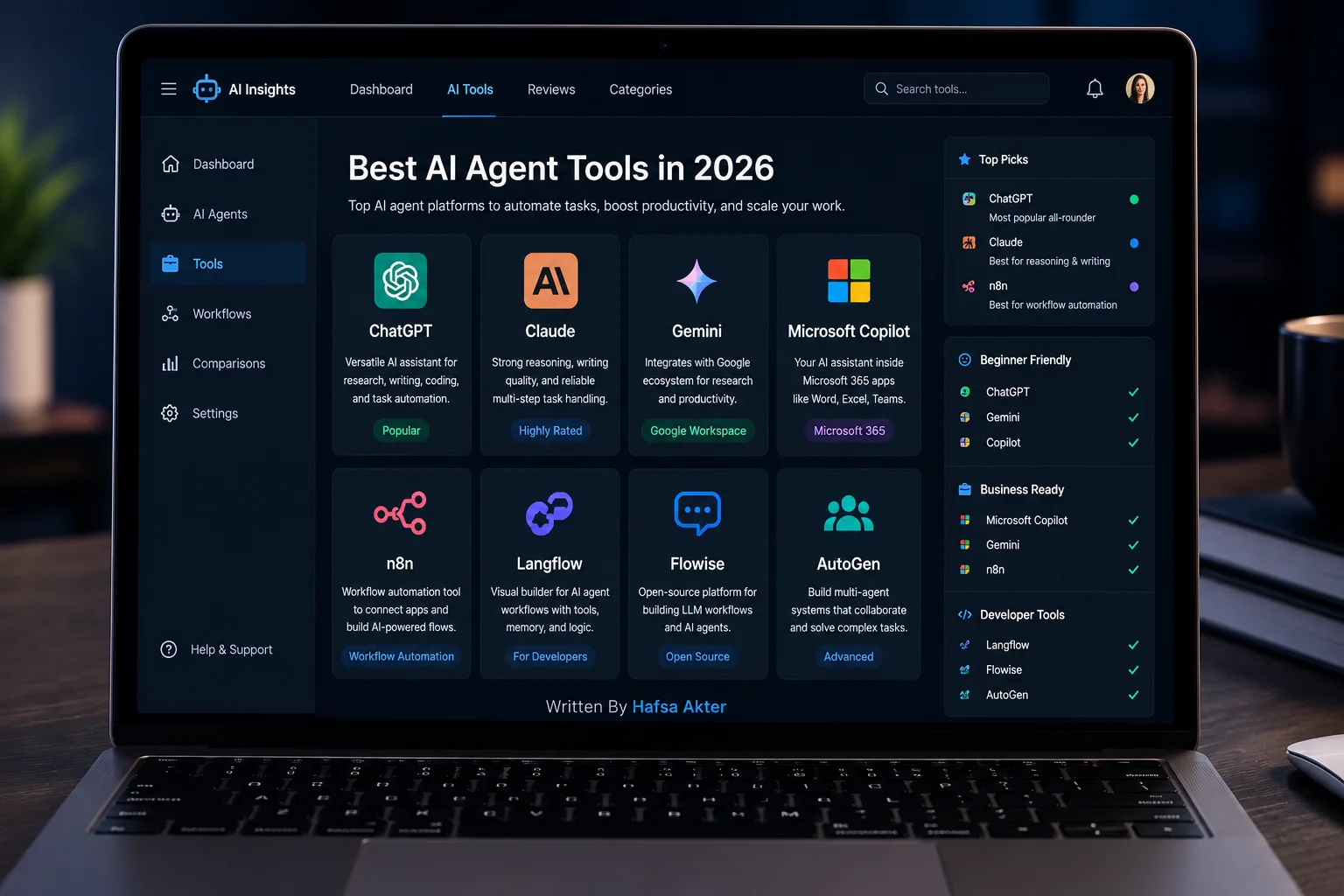
ChatGPT
Let's start with the one almost everyone's already heard of.
ChatGPT, made by OpenAI, is still one of the most widely used AI tools out there. It's grown well beyond "just chatting" — it can now browse the web, run code, and automate small tasks on its own.
Think of it as your all-rounder. Research, drafting emails, quick coding help, simple multi-step tasks — it can juggle all of that reasonably well.
Best for: Someone who wants one flexible tool that handles both everyday conversation and light task automation.
Claude
Next up — Claude, built by Anthropic.
If ChatGPT is the flexible all-rounder, Claude is the careful, detail-oriented one. It's known for strong reasoning and genuinely good writing quality. It can also work with files, run code, and complete multi-step tasks, just like ChatGPT — but it tends to shine when the task needs depth and precision rather than speed.
Best for: Professionals and teams handling complex, detail-heavy work — writing, analysis, coding — where getting it right matters more than getting it fast.
Gemini
Now, if you're someone who lives inside Google's apps all day — Docs, Sheets, Gmail, Search — Gemini is built for you.
It's Google's AI, and its biggest strength isn't some flashy feature — it's how tightly it fits into tools you're probably already using. It can pull information from the web and plug directly into your existing Google workflow.
Best for: Users already working inside Google Workspace.
Microsoft Copilot
Same idea, different ecosystem.
Copilot is built into Microsoft 365 — Word, Excel, Outlook, Teams. It actually started out more like a helpful assistant than a true independent agent, but over time, it's picked up more autonomous, task-driven abilities. Today it can summarize meetings, draft reports, and handle a good chunk of repetitive office work on its own.
Best for: Companies already running on Microsoft 365.
n8n
Here's where things shift from "chat with AI" to "build with AI."
n8n is a workflow automation tool. Instead of typing messages back and forth, you visually connect apps and services together — almost like drawing a flowchart — and some of those steps can include AI making decisions along the way.
Best for: Technical users or businesses who want detailed, customizable automation with a clear, visual layout of what's happening at every step.
Langflow
Langflow is a visual builder specifically for AI agent workflows.
It's popular with developers who want to experiment with how an agent reasons — chaining together logic, tools, and memory — without writing every single piece of it from scratch in code.
Best for: Developers and AI builders who want to prototype custom agent behavior quickly.
Flowise
Flowise is Langflow's open-source, drag-and-drop cousin.
It's especially popular for turning a basic chatbot into something closer to a full agent — one that can connect to your company's data, documents, and outside APIs.
Best for: Teams that want to build custom internal tools without needing a big development budget.
AutoGen
Last one on the list, and it's a bit different from the rest.
AutoGen, built by Microsoft Research, is focused on multi-agent systems — meaning multiple AI agents that talk to each other, split up tasks, and work together on something bigger. It's more code-heavy than the visual tools above, so it's really aimed at a technical crowd.
Best for: Developers and researchers building advanced systems where several agents need to collaborate.
Quick Recap, Tool by Tool
Before we move on, here's a quick rundown of everything we just covered:
- ChatGPT — best for general-purpose tasks, no coding needed
- Claude — best for detailed reasoning, writing, and coding, no coding needed
- Gemini — best for Google Workspace users, no coding needed
- Copilot — best for Microsoft 365 users, no coding needed
- n8n — best for visual workflow automation, minimal coding needed
- Langflow — best for custom agent prototyping, some coding needed
- Flowise — best for internal tools and chat-to-agent pipelines, some coding needed
- AutoGen — best for multi-agent collaboration, coding needed
So, Which One Should You Actually Pick?
Let's make this simple. Match yourself to one of these:
- Complete beginner, want help with research and writing? → ChatGPT or Claude
- Your business runs on Google? → Gemini
- Your business runs on Microsoft? → Copilot
- Want automation but don't want to code? → n8n
- You're a developer experimenting with agent logic? → Langflow or Flowise
- You need multiple agents working together on something advanced? → AutoGen
Here's the honest truth: there's no single "best" tool. It really comes down to your technical comfort level and which ecosystem you're already living in.
And a lot of businesses don't pick just one — they combine two or three. A common setup, for example, is using Claude or ChatGPT for the thinking and reasoning part, then using n8n to automate everything happening around it.
Wrapping Up
The AI agent landscape in 2026 has options for pretty much everyone:
Simple, no-code tools like ChatGPT and Claude for beginners
Fully customizable, developer-first platforms like AutoGen for advanced use cases
The right pick really just depends on two things: what you're trying to automate, and how much control you want over the process.
Once you've chosen a tool, it helps to understand the bigger picture — what these tools are actually good at, where they fall short, and where things are headed. That's covered in our next article, Benefits, Limitations & Future of AI Agents.
Frequently Asked Questions
Which AI agent tool is best for beginners?
ChatGPT and Claude are the easiest starting points — no coding required, and both handle general-purpose tasks well right out of the box.
Is Claude better than ChatGPT for AI agent tasks?
It depends on the task. Claude tends to be preferred for detailed reasoning, writing quality, and coding work, while ChatGPT is a strong, flexible all-rounder for everyday use.
What is the best free AI agent tool?
Open-source tools like Flowise and Langflow are free, though they need some technical comfort to set up. ChatGPT and Claude also offer free tiers with limited features.
Do I need to know coding to use AI agent tools?
Not for ChatGPT, Claude, Gemini, Copilot, or n8n — these are built for non-technical users. AutoGen and advanced Langflow setups, on the other hand, usually require coding knowledge.
What's the best AI agent tool for businesses using Microsoft or Google?
Microsoft 365 users generally get the most value from Copilot, while Google Workspace users benefit most from Gemini — both integrate directly into those ecosystems.
Can I combine multiple AI agent tools together?
Yes, and many businesses do exactly that. A common combo is a reasoning tool like Claude or ChatGPT paired with an automation platform like n8n to manage the surrounding workflow.
💬 Found this useful? Let's connect on [LinkedIn - Hafsa Akter] — I share more breakdowns like this regularly.