The Complete Beginner's Guide (2026)
ChatGPT as a personal AI agent means using ChatGPT's memory, browsing, task, and file-handling features together so it doesn't just answer your questions — it helps you actually complete real tasks, like drafting emails, planning your day, or researching something before you even finish asking.
Let's slow down and unpack that properly.
Imagine having an assistant available 24 hours a day. It remembers what you're working on. It helps you write emails. It plans out your day. It even researches something before you've fully finished asking about it.
Sounds like you just hired someone, right? A real employee, sitting right next to you.
Except — it's not a person. It's ChatGPT.
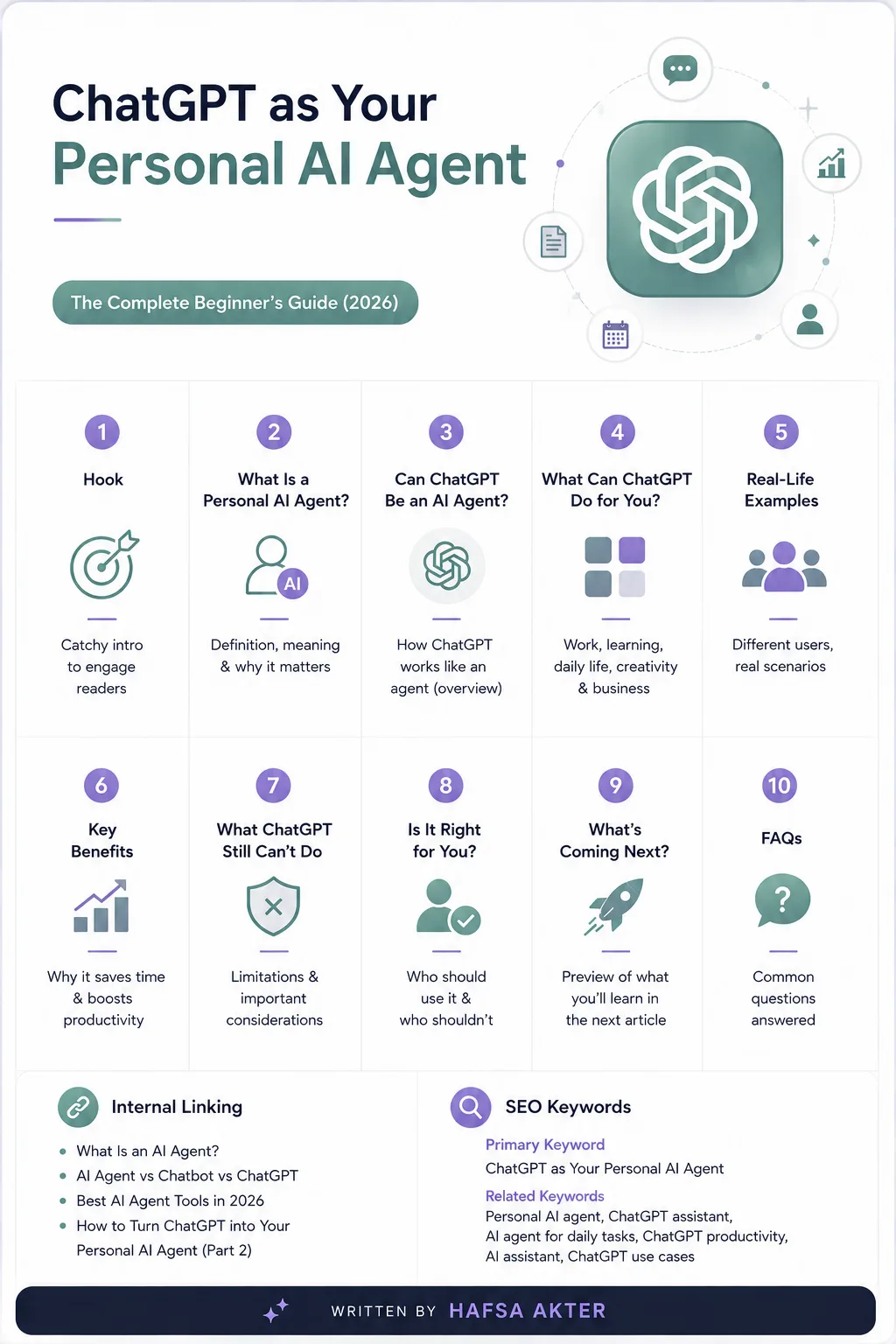
This is exactly what people mean when they call ChatGPT a personal AI agent. And in this guide, that's what we're going to unpack — what it actually means, what ChatGPT can genuinely do for you today, and where it still falls short.
What Is a Personal AI Agent, Really?
Okay, let's slow down here, because this term gets thrown around a lot without much explanation.
You've probably heard "AI assistant" and "AI agent" used almost interchangeably. They're not quite the same thing, though.
A personal AI assistant mostly answers your questions and helps with individual tasks — you ask, it responds. A personal AI agent goes a step further. It doesn't just answer — it helps you actually accomplish a goal, often stringing together several steps to get there.
So instead of "what's the capital of France," think more like, "help me plan my whole week, draft the emails I owe people, and summarize this report before my meeting." That's the agent mindset.
That's really why this term has picked up so much steam lately — people aren't just chatting with AI anymore. They're handing it real work.
Can ChatGPT Actually Be an AI Agent?
Fair question. Let's be honest about it.
At its core, ChatGPT was built as a conversational AI — you type, it responds. That's still true today. But over time, OpenAI has added features that push it well past "just a chatbot."
Here's where it starts acting agent-like:
- Memory — it can remember details about you across conversations, instead of starting fresh every time
- Browsing — it can search the web for current information instead of relying only on what it already knows
- File analysis — you can hand it a document, and it'll actually read and work with it
- Tasks — it can handle scheduled or multi-step actions for you
- Projects — it can keep related work organized together
- Voice Mode — you can talk to it like you would a real assistant, hands-free
We're not going deep into each of these right now — that's exactly what the next article in this series covers. For now, just know this: these are the features that turn ChatGPT from "a chatbot that answers questions" into something that starts to feel like a genuine personal agent.
What Can ChatGPT Actually Do for You?
Let's get practical. Here's what people are really using it for, broken down by area of life.
Work
Drafting emails, putting together reports, summarizing meeting notes — the kind of writing that eats up your afternoon.
Learning
Explaining tricky concepts in plain language, summarizing long PDFs, even building out a study plan for you.
Daily Life
Planning a trip, figuring out meals for the week, comparing prices before you buy something, keeping your schedule straight.
Creativity
Brainstorming ideas, writing blog posts, drafting social media captions, working out scripts for videos.
Business
Coming up with marketing ideas, helping with SEO, drafting customer replies, doing quick research before a decision.
Notice something here — none of these are one-off answers. They're all tasks. That's the agent part in action.
What This Looks Like in Real Life
Let's make this less abstract with a few quick examples.
A freelancer uses ChatGPT to draft client proposals and keep track of ongoing projects, saving hours every week on admin work.
A student uses it to break down a dense textbook chapter into something actually understandable, then build a study plan around an upcoming exam.
A small business owner leans on it for marketing copy, quick customer replies, and researching competitors — without hiring extra help.
A content creator uses it to brainstorm video ideas, write scripts, and repurpose one piece of content into five different formats.
A developer uses it to debug code, explain unfamiliar functions, and speed up the more repetitive parts of writing software.
Different people, completely different needs — same tool, adapting to each one.
Why People Are Actually Sticking With It
So what's the real payoff here? A few things keep coming up.
It saves time — genuinely, not just in theory. It's always available, no waiting for office hours. It helps you stay more organized, especially with memory and projects in play. Responses feel personalized once it knows more about your context. And overall, it just cuts down on repetitive work, which frees you up to focus on the stuff that actually needs a human brain.
Put it all together, and the honest result is: more gets done, with less friction.
What ChatGPT Still Can't Do
Now, here's the part that matters just as much — maybe more.
ChatGPT does not replace human judgment. It can absolutely make mistakes, sometimes confidently stating something that's wrong. It needs clear instructions — vague requests tend to get vague, unhelpful answers back. Its information can occasionally be outdated, especially on fast-moving topics. And there are real privacy considerations any time you're sharing personal or sensitive information with it.
None of this means don't use it. It means use it with your eyes open. Treat it like a very capable assistant — not an infallible one.
Is ChatGPT the Right Personal AI Agent for You?
Honestly, for most people, yes — to some degree.
- Students get a study partner that never gets tired of explaining things twice.
- Professionals get help with the writing and admin work that eats into real productive time.
- Freelancers get an assistant they don't have to pay a salary.
- Business owners get a research and marketing helper on demand.
- Developers get a faster way through the boring parts of coding.
- Creators get a brainstorming partner that's always available.
The specific way you'd use it looks different for each of these — but the underlying value is the same across the board.
What's Coming Next?
In this guide, you've learned what it actually means to use ChatGPT as a personal AI agent — the concept, the real capabilities, and the honest limitations.
In the next article, we'll get hands-on: exactly how to turn ChatGPT into your own personal AI assistant using Memory, Projects, Tasks, Browsing, Voice Mode, and Custom Instructions — step by step.
Frequently Asked Questions
Is ChatGPT actually an AI agent?
Not fully, in the strict technical sense — it can't act completely on its own without integrations. But with features like Memory, Browsing, Tasks, and Projects, it behaves agent-like for most everyday personal use, which is why people commonly call it one.
What is the difference between an AI agent and a personal AI assistant?
A personal AI assistant mostly answers questions and helps with single tasks. A personal AI agent goes further — it plans and works through multiple steps toward a goal, with less back-and-forth needed from you.
Can ChatGPT take actions on its own, like sending emails or booking things?
Not by default, without being connected to other apps or tools. On its own, it can draft the email or plan the booking for you, but you'd still need to hit send — unless it's linked to integrations that allow it to act directly.
What is a personal AI agent?
It's an AI tool that goes beyond just answering questions — it helps you actually accomplish tasks and goals, often handling multiple steps along the way.
Is ChatGPT free to use as a personal AI assistant?
Yes, there's a free tier with limited features. Paid plans unlock more advanced capabilities like extended memory and more powerful task handling.
Can ChatGPT automate daily tasks?
To an extent — yes. It can help draft replies, manage schedules, and handle scheduled tasks, though full automation usually needs it connected to other tools.
Who should use ChatGPT as an AI agent?
Students, professionals, freelancers, business owners, developers, and content creators can all benefit — the use case just looks different for each.
Is ChatGPT better than traditional virtual assistants?
It depends on what you need. ChatGPT is far more flexible and available around the clock, but a human assistant still wins on nuanced judgment and physical tasks.
💬 Found this useful? Let's connect on [LinkedIn - Hafsa Akter] — I share more breakdowns like this regularly.