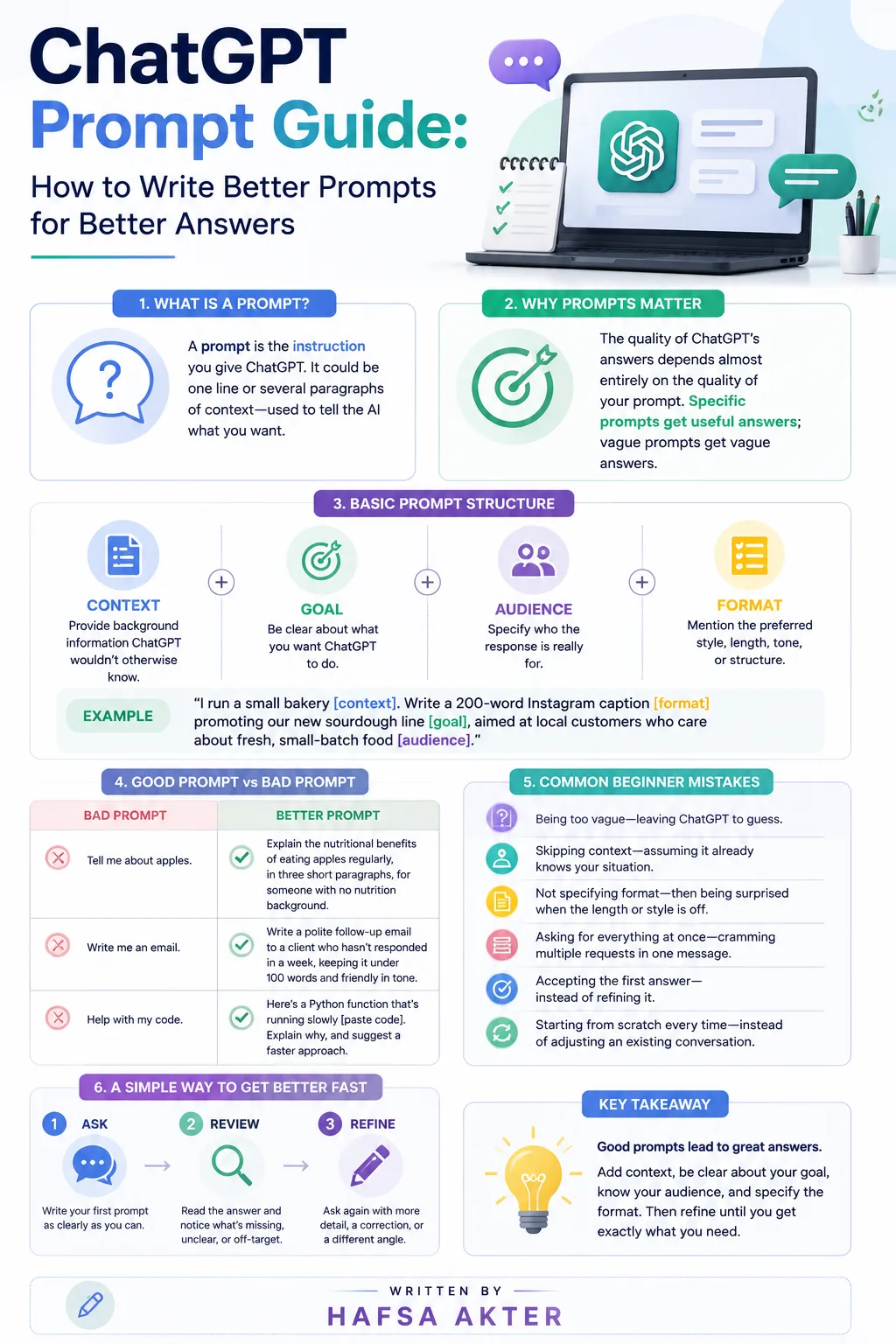
A prompt is simply the instruction you give ChatGPT — and the quality of your answer depends almost entirely on the quality of that instruction. A good prompt gives ChatGPT clear context, a specific goal, an intended audience, and the format you want back. Vague prompts get vague answers; specific prompts get useful ones.
Let's slow down and actually unpack that.
Here's something worth admitting upfront: most people blame ChatGPT for a bad answer, when the real issue is the question they asked. This isn't a knock on you — it's just how these tools work. ChatGPT can't read your mind. It responds to exactly what you give it, nothing more.
So this guide is really about one thing: learning to ask better, so you get better back. Let's start from the very beginning.
What Is a Prompt, Really?
Let's keep this simple.
A prompt is the instruction or question you give to ChatGPT. That's it. It could be one line, or it could be several paragraphs of context — but at its core, it's just you directing the AI toward what you want.
Think of it like asking a very capable assistant for help. If you say "handle the thing," they'd have no idea where to start. If you say exactly what you need, when, and how, they can actually deliver. ChatGPT works the same way.
Why Prompts Actually Matter
Here's the part people underestimate. ChatGPT doesn't have a fixed "quality level" — its output moves up or down almost entirely based on your input.
A weak prompt gives it too little to work with, so it fills in the gaps with generic guesses. A strong prompt removes that guesswork, so it can respond with something actually tailored to what you need.
This is really the whole reason "prompt writing" has become its own skill. It's not a gimmick — it's the difference between a mediocre answer and a genuinely useful one.
Basic Prompt Structure
Let's break this into a structure you can actually reuse.
Every solid prompt tends to include some combination of these four things:
- Context — background information ChatGPT wouldn't otherwise know
- Goal — what you actually want it to do
- Audience — who the response is really for
- Format — how you want the answer delivered (length, style, structure)
You don't need all four every single time, but the more of these you include, the more accurate your result will be.
A quick example:
Instead of:
"Write about marketing."
Try:
"I run a small bakery [context]. Write a 200-word Instagram caption [format] promoting our new sourdough line [goal], aimed at local customers who care about fresh, small-batch food [audience]."
Same topic. Completely different quality of output.
Good Prompts vs Bad Prompts
Let's look at this side by side, because seeing the contrast makes it click faster.
Bad prompt: "Tell me about apples."
Better prompt: "Explain the nutritional benefits of eating apples regularly, in three short paragraphs, for someone with no nutrition background."
Bad prompt: "Write me an email."
Better prompt: "Write a polite follow-up email to a client who hasn't responded in a week, keeping it under 100 words and friendly in tone."
Bad prompt: "Help with my code."
Better prompt: "Here's a Python function that's running slowly [paste code]. Explain why, and suggest a faster approach."
Notice the pattern? The better version always adds context, a clear goal, and some shape for the output. That's really the whole formula.
Common Beginner Mistakes
A few habits quietly hold people back from getting good results:
- Being too vague — leaving ChatGPT to guess what you actually mean
- Skipping context — assuming it already knows your situation
- Not specifying format — then being surprised when the length or style is off
- Asking for everything at once — cramming five requests into one confusing message
- Accepting the first answer — instead of refining it with a follow-up
- Starting from scratch every time — instead of adjusting an existing conversation
The good news: every one of these is an easy fix once you're aware of it.
A Simple Way to Get Better Fast
If you remember nothing else from this guide, remember this three-step approach:
- Ask — write your first prompt as clearly as you can
- Review — read the answer and notice what's missing, unclear, or off-target
- Refine — ask again with more detail, a correction, or a different angle
Prompting isn't usually a one-shot thing. Treating it as a conversation you refine, rather than a single perfect question you have to nail immediately, takes the pressure off completely.
What's Next?
Now that you understand what makes a prompt work, the next step is learning specific techniques that take this even further — role prompting, few-shot examples, step-by-step instructions, and more.
In the next guide, we'll cover — practical methods you can start using immediately.
Frequently Asked Questions
What makes a good ChatGPT prompt?
A good prompt is specific and includes context, a clear goal, the intended audience, and the format you want the answer in. The more of these you include, the more accurate the response tends to be.
Why do I get bad answers from ChatGPT?
Usually because the prompt was too vague or missing context. ChatGPT fills in gaps with generic assumptions when it doesn't have enough information to work with.
Do I need to write long, detailed prompts every time?
Not always — simple questions can stay simple. But for anything specific or important, adding a bit more detail almost always improves the result significantly.
Can I fix a bad ChatGPT response instead of starting over?
Yes, and this is usually the better approach. Continue the same conversation and ask it to adjust the tone, length, or focus, rather than starting a brand-new chat.
What is the easiest way to improve my prompts as a beginner?
Use the ask, review, refine approach — write your first prompt, see what's missing from the answer, then ask again with more detail. It's simple and works reliably.
Connect with me on LinkedIn for more guides like this.