Prompt engineering is the practice of writing and refining instructions so an AI model like ChatGPT produces the output you actually want. It combines clear structure (context, goal, audience, format), proven techniques (role prompting, few-shot examples, chain-of-thought, constraints), and ongoing refinement — and in 2026, it's evolved from a clever trick into a genuine, learnable skill.
Let's bring everything together properly.
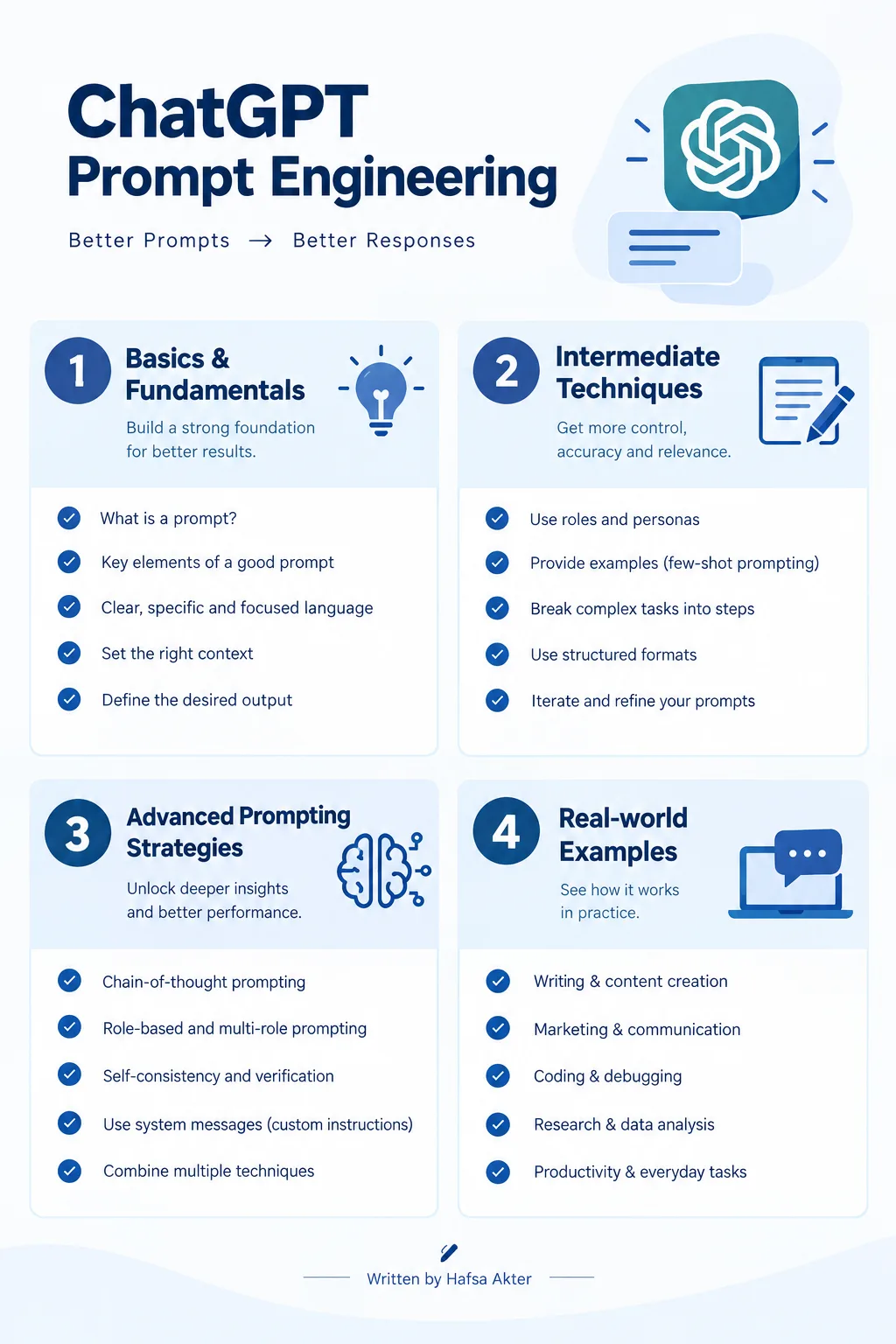
If you've read through this whole series, you already know most of what's in this guide — this is the piece that ties it all together into one place. If you're starting here instead, that's fine too. Consider this the complete picture, from the very basics to where this skill is actually heading.
What Is Prompt Engineering?
Let's define it simply. Prompt engineering is the skill of writing instructions — prompts — that consistently get an AI model to produce the result you want.
It's not about memorizing magic phrases. It's closer to learning how to communicate clearly and specifically with something that takes your words extremely literally. The same underlying AI can produce a mediocre answer or a genuinely great one, depending entirely on how the request was framed.
That's really the whole reason this has become a real, respected skill rather than a gimmick — a good prompt can improve output quality dramatically, with no upgrade to the model itself.
How Prompts Actually Work
Here's the simple version, without getting overly technical: ChatGPT predicts the most likely next words based on patterns learned from enormous amounts of text. Your prompt sets the direction for that prediction.
A vague prompt gives it very little to anchor to, so it falls back on generic, average patterns. A specific, well-structured prompt narrows that down sharply, pointing it toward exactly the kind of response you're after.
That's why the same question, worded two different ways, can produce two completely different quality levels of answer.
Core Principles of a Strong Prompt
If you remember nothing else from this entire series, remember this structure — we covered it in full in our foundation guide, but it's worth repeating here as the anchor for everything else:
- Context — background ChatGPT wouldn't otherwise know
- Goal — the specific outcome you want
- Audience — who the response is actually for
- Format — how you want it delivered
Almost every strong prompt includes some mix of these four elements. Master this, and you're already ahead of most people using ChatGPT.
Prompting Techniques Worth Knowing
We covered these in depth in our techniques guide, but here's the short version:
Role prompting sets tone and perspective by telling ChatGPT who to "be." Few-shot prompting shows it a couple of examples to match. Chain-of-thought prompting asks it to reason step by step, especially useful on standard chat responses for multi-part problems. Constraints set clear limits — length, tone, what to avoid. Output formatting defines exactly how the answer should look. Iterative prompting treats your first message as a starting point, not a final answer.
Each of these is a tool, not a rule — you'll usually combine two or three, not all of them, depending on the task.
Advanced Strategies for Accuracy and Reliability
For higher-stakes tasks, a few advanced moves make a real difference — covered in full in our advanced prompting guide:
- Give ChatGPT reference material instead of relying on its memory
- Explicitly allow it to say "I don't know" rather than guess
- Ask it to verify or critique its own answer before finalizing
- Break large, complex tasks into smaller chained prompts
One important, current nuance worth repeating here: persona prompts like "act as an expert" help with tone, but recent findings suggest they can actually reduce factual accuracy when used without real context — because they nudge the model toward sounding confident rather than being correct. Save personas for style. Use clear, specific instructions when accuracy is what matters most.
Common Prompting Mistakes
A quick recap of the habits that quietly undercut good results:
- Being too vague and expecting ChatGPT to guess your intent
- Skipping context it genuinely needs
- Not specifying format, then being surprised by the result
- Cramming multiple unrelated requests into one message
- Accepting the first answer instead of refining it
- Relying on personas instead of real, specific instructions when accuracy matters
Every one of these is an easy, immediate fix once you're aware of it.
Real-World Examples
Let's ground this in a few quick, practical examples pulling everything together.
Content creation: "You are a content editor. Using the attached draft, tighten it to under 600 words, keep the tone conversational, and flag anything unclear before finalizing."
Business research: "Using only the data in this report, summarize the three biggest risks to our Q3 plan. If the report doesn't cover a risk clearly, say so instead of guessing."
Learning: "Explain compound interest to a complete beginner using one simple real-world analogy, then give me three practice questions to check my understanding."
Notice how each one combines context, a clear goal, a format, and — where it matters — an accuracy safeguard.
Prompt Optimization
Prompt engineering isn't a one-and-done skill — it's iterative, even for experienced users. A simple way to optimize your own prompts over time:
- Write your prompt as clearly as you can the first time
- Review the output and note exactly what's off — too long, too vague, wrong tone
- Adjust one thing at a time rather than rewriting the whole prompt from scratch
- Save the version that finally worked, so you're not solving the same problem twice
Over time, you'll build your own personal library of prompts that reliably work for the tasks you do most.
The Future of Prompt Engineering
A few genuine shifts are already underway in how this skill is evolving:
- Context engineering — the focus is widening beyond the single prompt to the full context you feed a model: documents, memory, prior conversation, and connected data
- Multimodal prompting — combining text with images or other formats for richer, more accurate instructions
- Adaptive, self-optimizing prompts — AI systems increasingly adjusting to your style and refining prompts with less manual back-and-forth
- Prompt engineering as a workplace skill — more companies are formally training employees in this, rather than treating it as a nice-to-have
- Agentic systems — prompting is increasingly about directing a system that plans and acts, not just one that answers
The core idea underneath all of it stays the same, though: clear communication with AI is what determines whether you get an average result or a genuinely useful one. That part isn't going anywhere.
The Complete Series
If you want to go deeper into any part of this, here's the full path this pillar guide is built on:
- ChatGPT Prompt Guide: How to Write Better Prompts for Better Answers — the foundation
- 10 ChatGPT Prompting Techniques That Actually Work in 2026 — the core techniques
- 50+ ChatGPT Prompts for Work, Business, Content & Productivity — a ready-to-use library
- Advanced ChatGPT Prompting: How to Get More Accurate and Reliable Results — accuracy and reliability
- ChatGPT Prompt Templates: 25 Reusable Prompts for Everyday Tasks — reusable templates for daily use
Together, they cover everything from your very first prompt to the strategies experienced users rely on every day.
Frequently Asked Questions
What is prompt engineering in simple terms?
It's the skill of writing clear, specific instructions so an AI model gives you the output you actually want, rather than a vague or generic response.Is prompt engineering still a useful skill in 2026?
Yes — if anything, it's become more formalized, with companies increasingly training employees in it directly, even as AI models themselves get more capable.What are the core elements of a good prompt?
Context, goal, audience, and format. Including these four elements consistently produces sharper, more useful responses than a vague, one-line request.Do advanced prompting techniques still matter as AI models improve?
Yes, though which techniques matter most is shifting — some older tricks matter less on newer reasoning-focused models, while giving reference material and asking for verification remain consistently valuable.How do I get better at prompt engineering over time?
Treat it as iterative — write, review what's off, adjust one thing at a time, and save what works. Over time this builds into a personal library of prompts you can reuse reliably.
Connect with me on LinkedIn for more guides like this.